
Wounds Glorified
Finding Christ in Suffering and the Hope of the Resurrection

Author’s Note: This chapter has taken much longer to write than I initially anticipated. Unfortunately, my health has been a challenge lately. Fortunately, my time has also been preoccupied with many important family matters that have brought great joy. Thank you for your patience.
It is also worth noting that this post involves descriptions of bodily functions and procedures. I have tried to keep them from being graphic, however some level of description is necessary to convey the experience.
“We are such stuff as dreams are made on, and our little life is rounded with a sleep.” -William Shakespeare, The Tempest (Act IV, Scene 1)
I was a student in high school when I first came across this quote from William Shakespeare. I was captivated by it for some reason. It had a weight that lingered, despite my lack of context.
Years later, I heard this quote once more—this time spoken by the character Prospero during a 2005 production of The Tempest at the St. Louis Shakespeare Festival. I found myself drawn into his words. Illusions were unraveling. Prospero reminded us that everything we see—what our senses have come to trust—can vanish.
“Our revels now are ended. These our actors… are melted into air, into thin air…” -William Shakespeare, The Tempest (Act IV, Scene 1)
Prospero opened our eyes to a vision collapsing. Substance gave way to nothing. All appeared as though it had never been.
On October 14, 2025, I entered a theater of my own. The players included my doctors, their assistants, the nurses, and OR staff. The performance took place—not on a stage, but on an operating table. The anesthesia was pushed through my IV. I began to drift away. It was not a dream, nor was it sleep. I found myself somewhere in between—where time disappears and reality seemed to melt into thin air.
The Reality of the Wounds
I was taken from pre-op to the operating room around 1:30 pm on Tuesday, October 14, 2025. The fear that had started taking hold in pre-op faded away and joy returned. This was it. I was actually going into surgery to, hopefully, have the remaining metastatic tumors removed from my liver.
As we entered the operating room, I found myself amused by something I noticed during my previous cancer surgeries. The operating room did not look anything like those I’ve seen on television. Once again, the room seemed more like an incredibly clean mechanic’s garage or carpenter’s workshop than anything else.
I slid from the stretcher onto the operating table. The nurses and anesthesia team worked to get me comfortable. Then everyone present paused for something called a “timeout.” They quickly verified that I was the patient they were expecting, that I was there for a liver resection/ablation and partial right nephrectomy, and who would be doing what. I said a quick prayer of thanksgiving as they reviewed the plan and asked my guardian angel to watch over me during the surgery. I asked Jesus to lovingly welcome me home if I did not survive. Within moments of the timeout concluding, the anesthesia team placed an oxygen mask on my face and began pushing meds into my IV.
I don’t remember closing my eyes.
Coming out of anesthesia was a blur. I had just been lying on the surgical table with a mask on my face, but here I was in a quiet, dimly lit room. I am told I was in the operating room for over ten hours. The chill of IV meds flowing into my arm had ceased. Instead, I felt the dull, aching pain of the incision that stretched across my abdomen. The oxygen mask was replaced with a nasal cannula in my nostrils and an NG tube running up my nose and down the back of my throat.
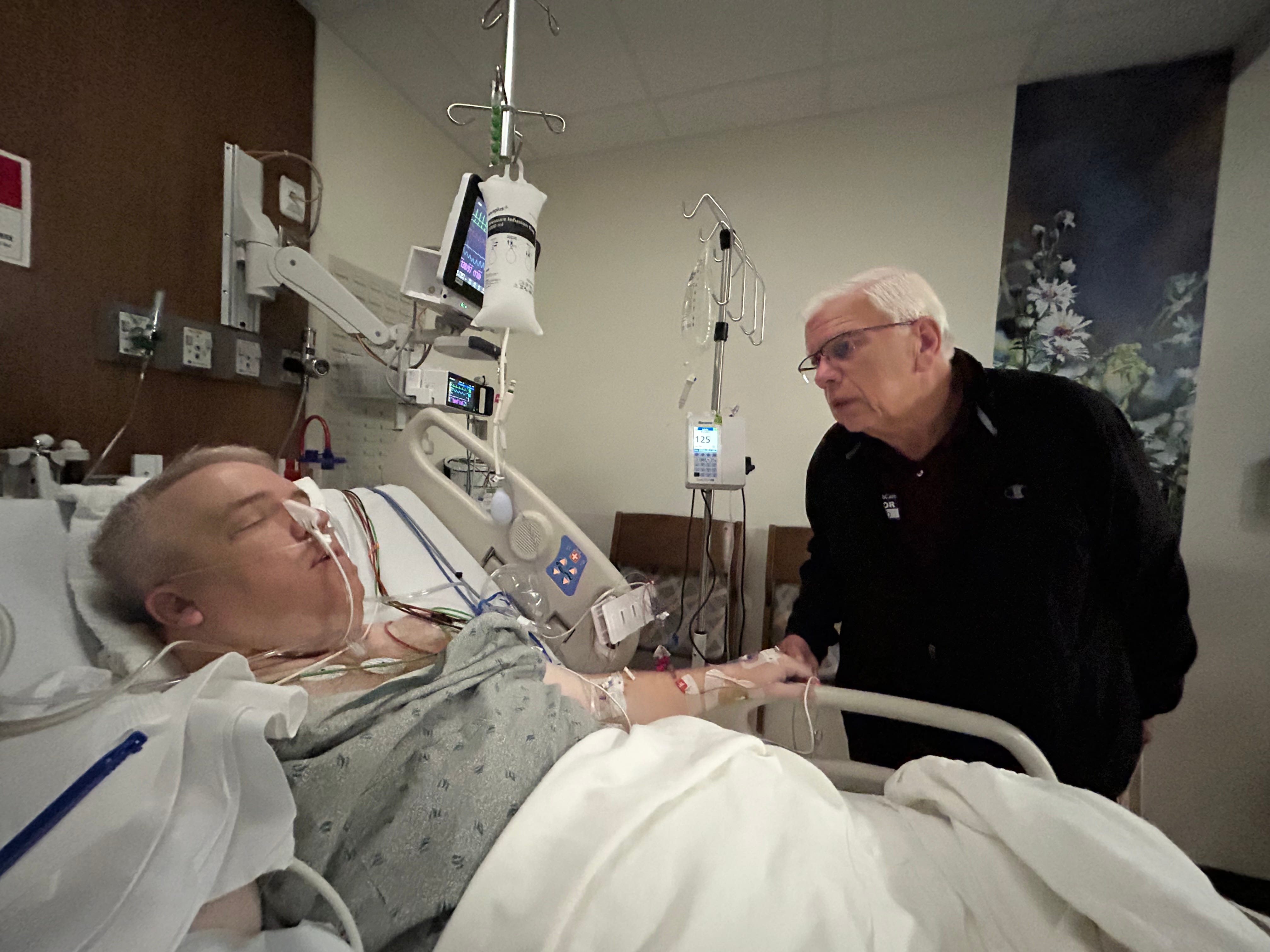
I vaguely remember seeing Beth and my parents in the recovery area. I have an inkling of a memory of being transferred to the floor where I would recover. Beyond that, my first firm memory is of rounds the following morning where I had already started asking if the NG tube could be removed.
An Invitation to Go Deeper
Up until this point, the only “surprise” was the NG tube. Everything else was aligned with my expectations following my previous surgeries. I was groggy. It was difficult to move or adjust myself in bed. There was a dull ache at the incision site. I had a sore throat from intubation tube that had been placed and removed. It was how I imagined it: similar, but more intense.
I went into this surgery with the mindset that, while this would be the most difficult surgery, I would make good progress if I could stick with the strategies learned in the previous surgeries: get up, move, walk, try to avoid using the PCA button (pain meds), and keep pushing through when it hurts.
It was a slow start. The NG tube and foley catheter kept me in bed. The length of the incision and the scale of the work performed by the surgeons made pain more challenging than I initially expected. But the NG and the catheter were removed later on Wednesday. It was time to try and walk. Just as I had expected, it was painful and depleted what little energy I had. We did it anyway. Wednesday may have been a slow start to recovery, but progress was made.
Thursday built upon the progress we had made on Wednesday. Beth helped me find the drive to walk. My nurse pushed me to be up in the chair instead of sleeping in bed. My diet was advanced from “sips and chips” (occasional sips of water with limited ice chips) to clear liquids. I still had the PCA button for pain meds, but was only using it following a transfer into bed. Thursday was a good day. It was exhausting, but we could clearly see that recovery was moving in the right direction.
Friday had the potential to be a “big” day. We knew we wanted to build upon the progress made on Thursday. My diet was advanced from clear liquids to “Whipple one” (a bland offering somewhere between liquids and soft foods). It was difficult to get started on Friday. The enthusiasm I had on Thursday had given way to a growing despondency. I was sitting in the chair when the hepatobiliary team came for rounds.
“Adam, how are you feeling today? You don’t look as good as you looked yesterday.”
I wasn’t feeling well.
My fatigue felt different than it had on Thursday. I was feeling nauseous. Did I push too hard on Thursday?
The hepatobiliary team cautioned me to listen to my body. Being in the chair was good and walking was still important. They advised me to stick to liquids if I was feeling nauseous.
“Don’t push it.”
Friday also brought a new concern. Not only was I getting nauseous, I had not passed gas or had a bowel movement since coming out of surgery. My care team was increasingly concerned that I had developed an ileus. That is to say, they were worried that a portion of my small intestine had not mobilized following the surgery. I wasn’t feeling much better by the time visiting hours ended at 9:00 pm. Beth went home. I tried to settle in for the night and get some rest. Perhaps I had just pushed too hard the previous day and needed time to recover.
I did not sleep much overnight. My night shift nurse did what she could to keep me comfortable. The discomfort and nausea continued to worsen overnight. My nurse came in just before 5:00 am to take my vital signs.
“Adam, I am going to speak with your doctor about a KUB.”
“What’s that?” I asked.
I learned that a KUB is an x-ray of the abdomen. The tech brought a portable x-ray machine to my room, slid a plate behind my back, and took the images. Rounds had started when my results came back. The floor doctor informed me that my small intestine was dilated and they were increasingly concerned that I had developed an ileus. The doctors reviewed a few scenarios that would require a new NG tube to be placed: continued inability to pass gas or have a bowel movement, worsening nausea, and/or vomiting.
My outlook was grim. My care team had already administered any medicinal aides they could give to help things move. It was no longer a question of “what we could do.” The only question: “will the medicines work in time?”
They did not. I was given my morning medicines shortly after 9:00 am. I gagged on one of the pills and proceeded to vomit. Luckily, Beth and my nurse were standing by with an emesis basin. My nurse looked at me and apologized.
“I’m sorry, Adam. I will need to let the doctors know this happened and they are most likely going to order the NG tube.”
I failed to see this in the moment, but this turn of events was an invitation to journey deeper with our Lord and enter more fully into His suffering.
A New Wound
I have often reflected about the surgical wounds I have received as a result of my diagnosis. One thing in particular sticks out as I ponder them as a participation in the wounds of Jesus on the Cross. Our Lord was fully awake and conscious as His wounds were inflicted. I was neither awake nor aware as the scalpels pierced my skin. I was given the comfort of general anesthesia. He was given a sponge soaked in wine mixed with gall. My wounds, though they were painful, were a fraction of what Jesus endured. This changed on October 18, 2025.
My nurse came into the room after conferring with the doctors. Two things were going to happen in a relatively quick fashion. First a nasogastric tube (NG tube) would be inserted into my nose. It would go through the nasal cavity to reach the throat, down my esophagus, through my stomach, and into my small intestine. The nurse would then place a foley catheter as there was also a growing concern that I was not sufficiently emptying my bladder. I would be awake for both procedures. She then left to gather the necessary supplies.
The nurse returned, sat me up in bed, and laid the supplies out on the table. I held onto the side rails of the bed as she unwrapped the tube. As she inserted the tube into my nostril the sensation was unbearable. I remember several times I went swimming as a kid where I would jump into the pool or my older brother would dunk me and water would rush up my nose. The tube placement took this to a new dimension. It was a prolonged version of the same sensation, but worse.
She advanced the tube into my throat and I immediately triggered my gag reflex. I suddenly felt an urgent need to vomit. My nurse was prepared for this and already had given me an emesis basin to hold. I finished vomiting. She resumed her work advancing the NG tube. Soon, it seemed she had finished. The sensation was still awful. Comfort felt completely out of reach.
My nurse then informed me that, while she was confident the NG tube was properly inserted, she would need to ask the doctor to order another KUB before we could secure the things. I would need to sit still until we had confirmation. Moving could dislodge the tube and possibly require withdrawing it and reinserting. I desperately wanted to lay down, but I sat frozen as she left the room. I lost track of time while we waited for the scan. My nurse sat patiently with me. Minutes seemed like an eternity. I was inconsolable. The tube started creeping out on its own. My nurse slowly and gently advanced it to resume its original depth.
The KUB showed we needed to advance the NG another few inches. I asked if we could go slowly, perhaps a few millimeters at a time. It was much more bearable than the previous rate of insertion. She was confident the NG tube was now sufficiently advanced. An additional KUB image confirmed her confidence. She taped the tube to my nose and face so that it would remain in place.
It was now time to lie down so that a foley catheter could be inserted into my bladder. The nurse warned me that it would be moderately uncomfortable, but that it should not be painful. I cannot imagine I would tolerate catheter insertion as well as I did in that moment. The pain and discomfort of the NG tube had such a tight grip on me that I did not really flinch when the catheter was inserted.
The doctor had come into the room at some point during this course of events. He could clearly see that I was miserable and apologized that things had come to this point. Unfortunately, I would need these interventions for at least twenty-four hours. In the midst of his explanation, I was overcome by the sure feeling that I was about to have a bowel movement. I somehow communicated this to my nurse through the gagging caused by the NG tube. There was no conceivable way that I would be able to make it out of the bed. The NG tube, foley catheter, and my IV’s were like ropes lashing me to the bed. My nurse was prepared for this. She instructed me to use my feet and arms to lift my hips off of the bed as high as possible. She quickly slid a bed pan lined with an absorbent pad underneath me. Within seconds I felt the quick expulsion of mushy stool from my body. I was immediately reminded of every “blow out” diaper our children had as infants. I was both a literal and figurative mess.
Looking back, this was the closest I think I’ve come to participating in the piercing of Christ’s hands and feet with the nails of His crucifixion. My participation paled in comparison to what He endured, but it was the single worst experience I’ve endured so far.
The Balm of Compassion
The series of events that afternoon was, without a doubt, one of the most defeating moments of my journey. I had vomited multiple times, was lying in a pile of my own feces, and any pretense of modesty had been removed when the catheter was inserted. I couldn’t move and was fully dependent on Beth and my nurse to now clean me, change me, and change my sheets (all with me still in the bed).
And yet, one of the most amazing things of the experience was my nurse’s demeanor. She exhibited nothing but compassion. At no point did I feel as if she was repulsed by what had transpired. Her focus was clear. She cared for me with great tenderness, reminding me through each step that “it [was] okay.”
By the time all was said and done, she had me resting as comfortably as possible in my freshly changed bed. The hours that followed would continue to be agonizing. I could not turn my head or move my body without gagging. I did not sleep much that evening. Instead I laid awake in bed praying a variation of a familiar prayer.
“It’s for You, Lord. If You want it, please help me to want it too because I do not want it.”
Morning came and Beth soon arrived to sit quietly with me. At a certain point she helped me muster the energy and motivation to walk despite the misery.
My nurse returned that day shift and was assigned to me once again. It was a great joy when she informed me that my bowels had made enough progress moving in the right direction for the NG tube to be removed and that she was the nurse who would remove it.
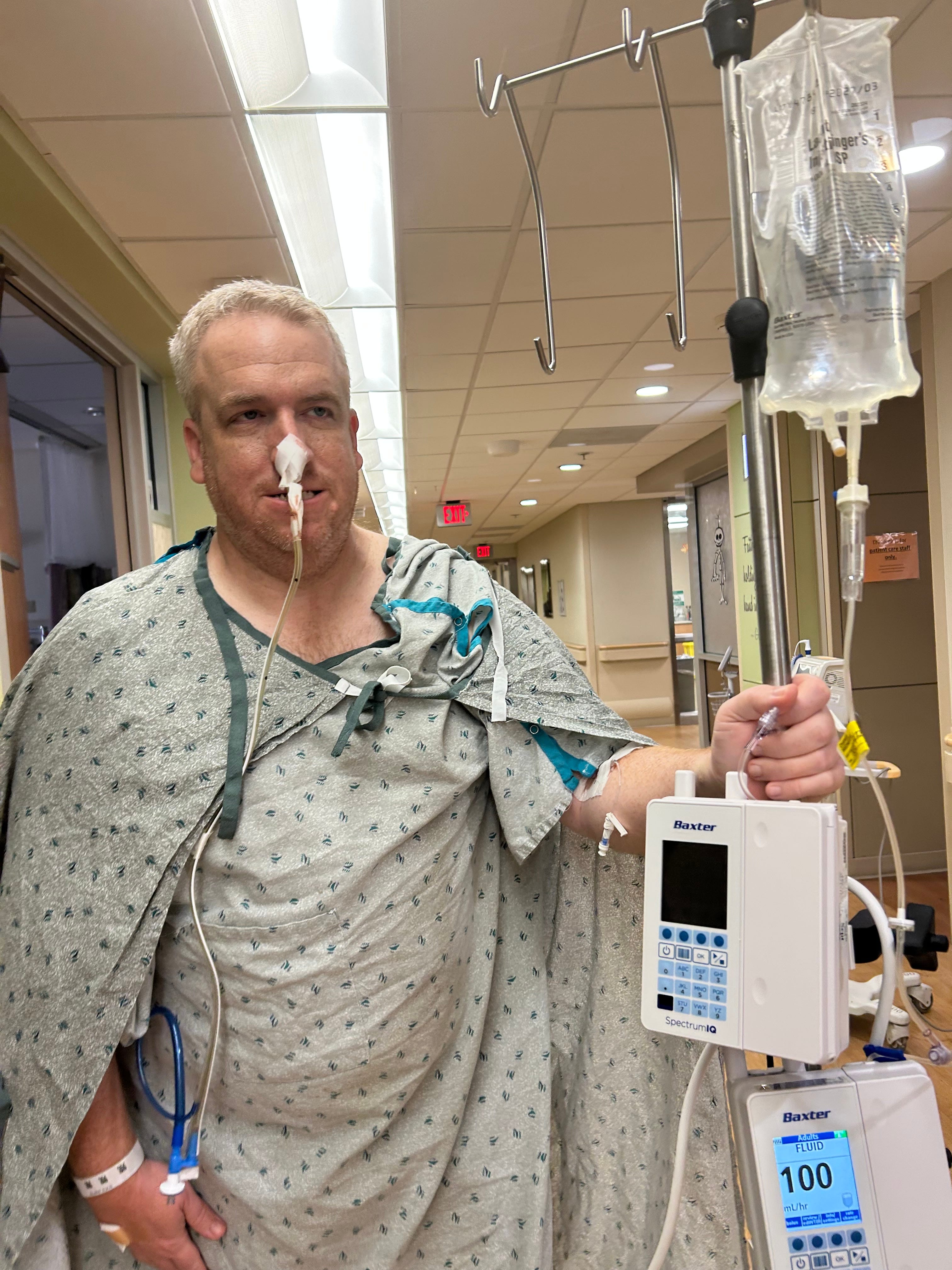
“Mr. Adam, can we still be friends?” she asked after removing the NG tube the following day?
I laughed and said, “yes.” We may not be actual friends, but an overwhelming gratitude remains in my heart for the care she gave me and the manner in which she gave it.
Wounds Glorified
In the moment, I never thought the NG tube would come out. I had lost confidence that my muscles would heal. I was frustrated by my near complete dependence on others to accomplish simple tasks of self-care. Darkness, pain, fear and frustration seemed to be my only companions.
Over eight months have elapsed as I write this reflection. The unbearable NG tube placement is now a memory. I can use the bathroom without assistance with few exceptions. I am able to clean and dress myself. But the scars remain.
An 18 inch scar transects my abdomen from the surgical incision. Abdominal pain and discomfort still linger due to adhesions, scar tissue, and changes in anatomy. I am reminded daily of what elapsed and at times haunted by the memories.
There is also hope.
My utter dependence on others during my initial recovery was a sobering reminder of my dependence upon God to make it through this life. One day I will die. My hope is that every aspect of my journey with my cancer has brought me closer to God. I continue to pray that He is using it to mold me into the saint He has called me to be. Heaven will be the measure of success.
“I believe in one, holy, catholic and apostolic Church.
I confess one Baptism for the forgiveness of sins
and I look forward to the resurrection of the dead
and the life of the world to come.Amen.”
-The Nicene Creed
I profess the Nicene Creed at Mass every Sunday. I do not take it lightly. I do believe in the resurrection of the dead. I believe that we will be reunited with our bodies as Jesus was with His following His resurrection on Easter Sunday. I believe that, if I make it to Heaven, my body will be glorified just as His was.
My hope is that I will one day look upon my scars, not as reminders of the pain that I endured, but as instruments that God used to lead me to sainthood. Rather than dwell in the shame of the day my NG was placed, I will rejoice knowing that God reached into the mess of my life and drew me closer to Him through the grace bestowed in the moment.
“Those who share in Christ’s sufferings have before their eyes the Paschal Mystery of the Cross and Resurrection, in which Christ descends, in a first phase, to the ultimate limits of human weakness and impotence: indeed, he dies nailed to the Cross. But if at the same time in this weakness there is accomplished his lifting up, confirmed by the power of the Resurrection, then this means that the weaknesses of all human sufferings are capable of being infused with the same power of God manifested in Christ’s Cross.” -St. John Paul II, Salvifici Doloris (p. 23)
Reflection Questions
When have I found myself completely dependent on the help of others? How did that experience affect me?
Who has shown me the compassion of Christ during a difficult season of my life?
Are there wounds, scars, or painful memories that I still view primarily as sources of shame rather than places where God has been at work?
What would it look like for me to trust that God can bring grace even from the most humiliating or painful moments of my life?
When I profess belief in “the resurrection of the dead and the life of the world to come,” how does that hope shape the way I view my present sufferings?
If you feel comfortable sharing, I’d be grateful to hear about a time when God met you in the midst of suffering, weakness, or dependence on others.