
"I Should Not"
Learning Obedience to Limits

The “newest normal” was in full swing.
The mass in my brain was regularly affecting daily life. Migraines and spells of vertigo were now accompanied by overwhelming fatigue from the anti-seizure medication. Anxiety and stress continued to manifest themselves with unpleasant GI distress. The combination of these symptoms led to restless nights, which only worsened everything.
We even reached a tipping point where I was taken to the emergency room by ambulance due to the nature of the symptoms. Why? Because “the doctors said so” — the familiar refrain when reviewing discharge instructions. Medication doses were adjusted, and I was sent home once again.
My MRCP scan results had come back in the midst of this. The liver surgeon called to tell me everything looked the same. Surgery to remove the liver metastasis would be possible, but not yet. Prior to this, she was not willing to operate because she thought it would be unsuccessful. Now she was unwilling to operate until the doctors resolved the issue with my brain. The hope at the beginning of the call was immediately followed by disappointment. It was another instance of the “new normal.”
A Fitting Season
Whether it was coincidence or providence, this latest part of the adventure coincided with the season of Lent. I have regularly practiced this season of prayer, fasting, and almsgiving throughout my entire life. The routine was simple, find something that is part of daily life and willingly choose to abstain from it from Ash Wednesday through Easter. Why? There are many reasons, but a significant reason for me has been the desire to grow closer to God by detaching from the comforts of life and focusing on my dependence on Him. Little did I know that I would be living this out in a extraordinarily different way this time around.
There were some key instructions when I was discharged from the hospital after my brain mass was discovered. One stood out among the others. I was advised to rest. This made sense. Afterall my body was fighting cancer. The symptoms were significantly disrupting my sleep cycle. But the doctors took it a step further.
“Adam, it is very important that you listen to your body. When you get tired, you need to stop what you are doing and rest.”
They were very clear. I would get tired. It would happen frequently.
I had been conditioned for most of my life to push through fatigue. If I was tired at work, I would pour another cup of coffee and do whatever I could to tighten my focus. Home life often involved a “check-list” mentality when tired. I would be able to sleep after I finished whatever tasks had to be accomplished that evening. Social opportunities were routinely weighed against my need for sleep. I was happy to be tired the next day if it meant we could have some fun tonight.
Once again, the doctors were very clear. Ignoring the symptoms would make things worse and carried significant risks. There was still some debate whether or not the symptoms that first led to diagnosing the brain mass included partial seizures. My doctors warned that, if they were seizures, pushing through the fatigue could trigger more seizures.
It soon became a regular occurrence that I would have to abstain from the activities of daily life due to exhaustion and fatigue.
I Cannot vs. I Should Not
Earlier in my journey, I ventured through a season I called “I Cannot”. It was immediately following my first surgery and stemmed from the reality that my muscles were torn, my body recovering, and I literally could not do simple things such as sitting up on my own. In many ways, I was forced to the sidelines. I couldn’t have participated in many of the daily activities of life no matter how much I tried.
This season was different. If the previous one was a season of “I Cannot,” this one would be better named “I Should Not”.
It was a difficult path to walk. I had similar restrictions following the surgery. They were easier to follow because I did not have the physical ability to push beyond them. Now it was a matter of temperance, prudence, and fortitude — virtues that require choice, not just acceptance.
Fatigue would come. It was incredibly frustrating and particularly disruptive. There were several times I walked into my boss’s office and said, “I have to leave now. I’m not sure if I will be back.” The voices of my employer and co-workers were incredibly supportive. They constantly urged me to take care of my health. The voices in my head were constantly ridiculing me, “Does the big boy need a nap?”
The temptation to ignore the fatigue was strong. I did not want to yield to my limits. Pride had a firm grasp on my resolve. After a few days of following the doctor’s orders, I decided to ignore their warnings and push through my fatigue. I had work to do and I was going to see that it was finished. It was difficult, but I did it. I powered through the day’s agenda, went home, ate dinner, and went to bed. I thought I had achieved a victory. The next morning showed how wrong I was.
I did wake up when the alarm clock went off the next morning, but I could not muster the energy necessary to get out of bed. I finally managed to get from our bed to the bathroom, turned on the shower, and proceeded with my morning routine. Everything felt as if I was moving in slow motion. After a few minutes of standing in the shower, what little energy I had quickly faded, I knocked on the wall to alert Beth that I needed help. I no longer had the strength to turn off the shower, get out, and dry myself without assistance. She came to help and then assisted me back to bed.
I called my boss before going back to sleep. I would not be able to come in to do the morning radio show. They would need to cover the program with something else. In my mind, I had failed.
The consequences of doing what I “could” do clearly illustrated the price of ignoring what I “should” do.
It took a few days to recover from this particular episode. Another opportunity to put my resolve to the test soon arrived. I remembered the consequences. I listened to my body this time. I went home and took a nap. I even woke up feeling somewhat refreshed and headed back to the office. While the rest of the day proceeded without incident, the next morning did not.
I was once again unable to muster the energy needed to get out of bed and get ready for the day. It was not for lack of willpower. I just did not have the energy. This experience quickly joined the ranks of the “new normal.”
The Burden of Suffering
A friend messaged me when I first publicly shared my cancer diagnosis. He had heard me say, “Jesus is inviting me to walk a very particular Way of the Cross with Him.” His message was simple: “When you fall, remember that Jesus fell three times too.”
We had started praying for the grace to suffer well at the onset of my journey. Somewhere along the way, the fruit of that prayer became harder to recognize. I couldn’t help but wonder where the grace had gone. Was God no longer offering it or was I failing to receive it? Frustration had replaced patience. I went from viewing my brain mass as “just another thing” to constantly questioning “why” within a matter of weeks.
“Jesus, why are you allowing this?”
Peace That Does Not Depend on Answers
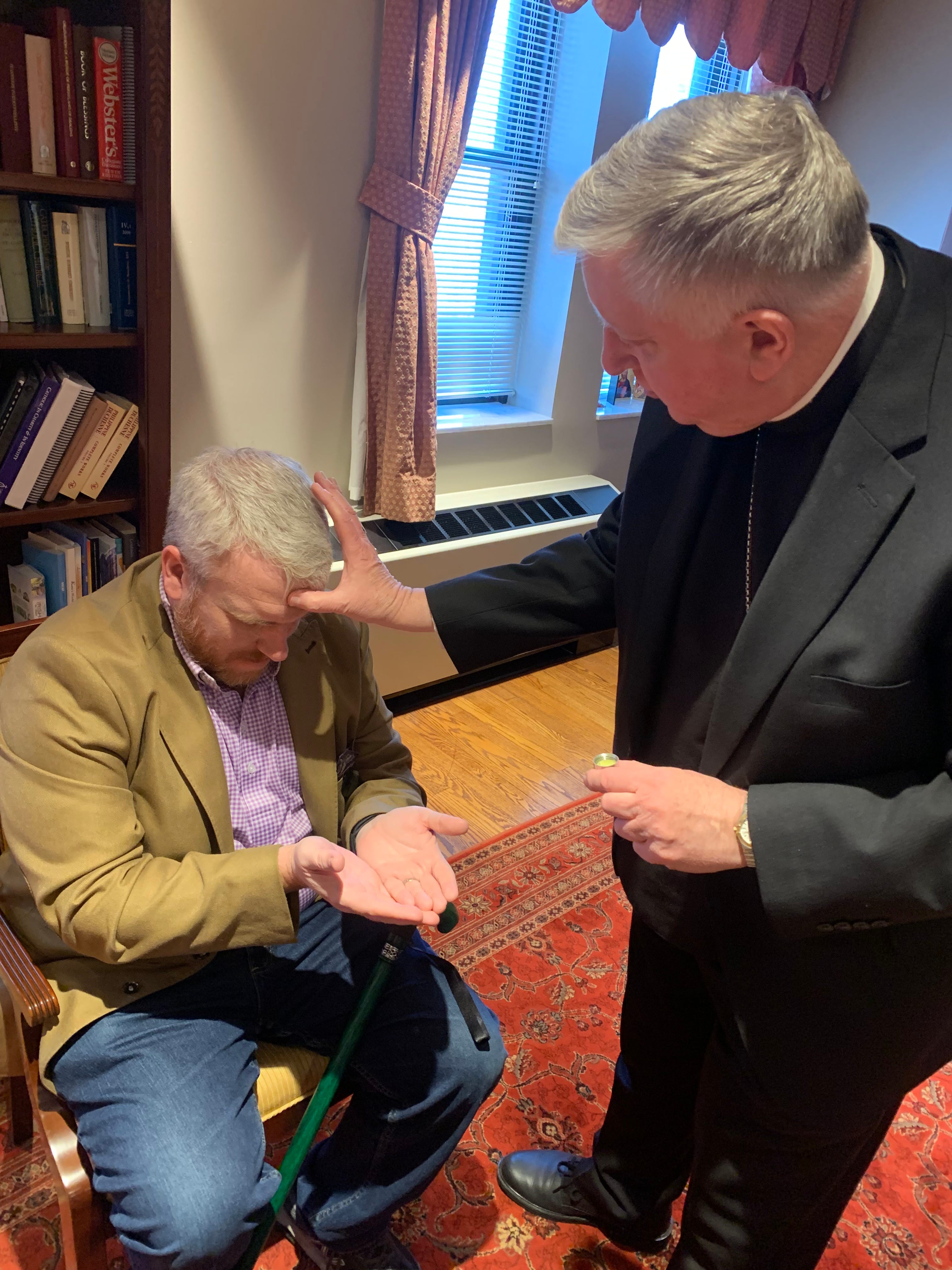
Another constant throughout my illness was sacramental anointing. Our parish regularly offered Anointing of the Sick during a Mass on the first Saturday of the month. Several priest friends had come to anoint me. A good friend had made arrangements for the Archbishop of Saint Louis to anoint soon after I was discharged from the neuro unit. It just so happened that his schedule best aligned with this period of desolation.
The ritual itself is fairly straightforward. It includes asking for God’s mercy, asking for healing, and asking for assistance to bear the burden of suffering. We ask God, if it be His will, to heal us of our ailments. We also ask Him to prepare us to be with Him in Heaven when this earthly life has ended.
The ritual began with the Archbishop offering a seemingly simple greeting.
“Peace be with you.”
As the ritual continued, I was struck by the familiar words of the prayer as the Archbishop anointed my forehead and hands with the Oil of the Infirmed.
“Through this holy anointing may the Lord in his love and mercy help you with the grace of the Holy Spirit. Amen.
May the Lord who frees you from sin save you and raise you up. Amen.”
So much of our prayer had been focused on physical healing. We were constantly petitioning that God would remove the cancer. Prayers were added that the mass in my brain would be also be healed. The ritual did not discount these intercessions, but focused on a higher priority.
We returned to a question of trust. Did I trust the efficacy of these words? Our Lord granted the Church, and the bishops and priests of the Church, the authority to act in the person of Christ when administering the sacraments. The Archbishop, a successor to the apostles, possessed the fullness of Holy Orders when conferring the Sacrament. If he was offering the peace of Christ and asking the Lord to assist me with the grace of the Holy Spirit, how could our Lord refuse to pour out peace and grace?
My friend texted me later in the evening to thank me for allowing him to be present and pray with us. He asked how I was feeling. I shared with him that I was tired, but very much at peace following the anointing. I didn’t believe it was coincidental. It was the efficacy of the Sacrament. It was the power of prayer. It was the trust that hope gives, reminding us that Heaven is greater than any melancholy or suffering we might be enduring at the present time.
Reflection Questions
Where in your life are you able to do something — but perhaps should not?
How do you typically respond when your limits feel imposed rather than chosen?
Do you find it easier to accept incapacity or to obey restraint?
Where might God be inviting you to receive grace rather than prove endurance?
What does “peace” mean to you when answers are still absent?